How many minutes do you really have when a tree is splitting in the middle of a storm in a narrow Manhattan street, and it is 40 feet in length? The emergencies with the trees in New York City and in Manhattan, in particular, do not develop gradually. They get out of control very quickly, even within a few seconds, due to high traffic jams, traffic parking, people, power cables, and crowd-filled buildings. There is a split trunk, a hanging branch, or an uprooted tree, not merely a landscaping problem; in this case, it is a crisis in public safety that requires an emergency tree service, close and quick.
City life in Manhattan poses a highly differentiated threat. Trees planted on soil beds that are limited, along underground utilities, adjacent to old brownstones and under continuous pollution and construction vibration. Once something is wrong, it becomes wrong in a very visible and audible way.
Knowledge of what can be considered a tree emergency, how same-day response actually functions in Manhattan, and what can be expected by the homeowner, property managers, and business owners can save thousands of dollars and, more importantly, prevent serious injury.
Why Tree Emergencies Are More Dangerous in Manhattan Than Anywhere Else
In suburban settings, the emergencies of the trees are frequently enclosed in the backyards. It is the luxury that is not there in Manhattan. One collapsing tree will block a street, squash cars, destroy exteriors, snap utility tunnels, or even bring down power lines. The risk radius is far wider.
Most of the emergency calls in Manhattan include situations like:
- Huge limbs over the sidewalks or cars.
- After heavy precipitation trees lean towards structures.
- Trees that were damaged by storms that got stuck in utility lines.
- Trees uprooted and sidewalks and gas lines.
- Broke trunks due to internal or high wind damage.
Because Manhattan is a blocky, very busy street, there is no time to spare. A partially malfunctioning tree can cause a violation of the law, a lawsuit, or even an emergency shutdown.
What Qualifies as a True Tree Emergency in Manhattan
Not all ruined trees are an emergency but in Manhattan it is less and more about public exposure. An emergency involving the trees is a case where the immediate threat is on the people, property, or infrastructure.
Examples include:
- A tree or branch actively falling or fallen.
- A tree that has bent at a right angle due to a storm or excavation.
- Split trunks which are structurally defective.
- Trees against buildings, scaffold, or fire escapes.
- Limbs lying on power or communicational lines.
What most property owners are not aware is the fact that a tree can become an emergency without any notice of what has occurred to it internally. Trees can appear to be healthy externally, but become diseased internally through fungal rot, girdling roots or affected soil structure- which is usual in the compacted urban soil in Manhattan.
Same-Day Emergency Tree Response: What Actually Happens
At the same time when you request same-day emergency tree service in Manhattan, you will be having a totally different response as compared to ordinary tree works. Speed is important, and coordination is important.
The usual process starts with an instant on-site risk assessment. Certified arborists assess:
- Head of lean or failure.
- Limbs or trunk load pressure.
- Accessibility to pedestrians, vehicles, and buildings.
- Exposure to power lines or underground power utilities.
Still, in most of the cases of Manhattan, emergency teams have to collaborate with Con Edison, NYPD, or FDNY. This coordination is imperative where trees are caught up with live wires or they are obstructing access paths to emergencies.
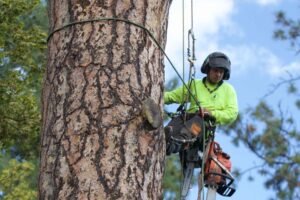
Contrary to normal tree removal, emergency response may need special rigging systems, crane or piece wise dismantling in order to take away the hazard safely without further damage.
Why Manhattan Emergency Tree Work Requires Specialized Equipment
Tree service in Manhattan is not a chain/jack-and-truck business. The city congestion requires superior equipment and skilled personnel.
Commonly used equipment is:
- Truck mounted cranes used in vertical removals.
- Controlled limb lowering rigging systems with high capacity.
- Raisers that are being aired in narrow urban areas.
- Protective mats on the ground to protect the sidewalks.
Some of the streets in Manhattan cannot be completely closed, and thus arborists have to cut down the trees at times through moving traffic or overcrowded footways. This is the point of high technicality and this is why the issue of experience and certification is of great importance in this field than any other.
The Role of Weather in Manhattan Tree Emergencies
The most common cause of emergency tree calls in Manhattan is the weather. Structural fall of the trees is caused by nor’easters, summer thunderstorms, heavy snows, and abrupt bursts of wind.
Through high-rise building, wind tunnels occur and exert pressure differentially on the tree canopies. Rain is seen to soak already compacted soil, making root systems weak. Snow and ice place untold pressure on the limbs that were not intended to support its weight.
One very important point that should not be overlooked: the majority of trees fail when the storm is already over but not at the moment. Delay collapses are typical and that is why, inspections of same-day after heavy weather are necessary.
What Property Owners Are Legally Responsible For
In Manhattan, responsibility for trees depends on ownership and location. Private property owners are generally liable for trees located on their land, even if branches extend over public sidewalks.
If a hazardous tree or limb causes injury or damage and it can be shown that the owner failed to act on visible warning signs, liability can be severe. This includes:
- Cracks in the trunk
- Dead or hanging branches
- Noticeable lean or root upheaval
How Emergency Tree Removal Differs From Regular Tree Removal
Emergency tree removal prioritizes hazard mitigation, not aesthetics. The goal is to neutralize immediate danger as fast as possible.
Key differences include:
- Work may begin without prior scheduling
- Crews may work after hours or overnight
- Partial removal may occur first to stabilize the tree
- Cleanup may be phased rather than immediate
Cost Factors in Same-Day Tree Emergencies
Emergency tree service costs more than scheduled work, especially in Manhattan. Several factors influence pricing:
- Time of day or night
- Severity of the hazard
- Need for cranes or special permits
- Street closures or police coordination
- Accessibility of the site
What to Expect During the Emergency Response Process
From the moment the crew arrives, expect a controlled but fast-moving operation. Areas may be cordoned off. Pedestrian traffic redirected. Vehicles temporarily relocated.
Arborists communicate clearly about:
- Immediate risks
- Steps required to make the site safe
- Whether full removal is necessary or stabilization is possible
The Importance of Certified Arborists in Emergency Situations
One of the riskiest occupations in the urban setting is emergency tree work. Certified arborists offer important knowledge in tree anatomy, stability and proper removal methods.
They do not merely hack, they prescribe. The knowledge of the failure of a tree will assist in preventing any future effects of the same property particularly when the failings of the soil, root damage, or species susceptibility have taken place.
Preventing the Next Tree Emergency Before It Happens
Emergencies cannot be predicted all the time, however, most of them can be avoided by active treatment. The frequent inspections, structural pruning, and soil control play a great role in reduction of risk.
The trees in Manhattan are exposed to special stressors, which include limited root space, pollution, construction vibration etc, and the trees need special maintenance strategies. The solution to these early can be the difference between a planned pruning job and a middle of the night emergency operation.
Why Local Manhattan Experience Matters
Your approach to tree care should be more nuanced and considerate of the specific requirements tied to the zoning, street layouts, and infrastructure of Manhattan. With insufficient familiarity to the borough, crews tend to underestimate the complexity and logistical challenges associated with tree removal which results in delays, and sometimes, unsafe practices.
Experience with the area translates into quicker response times, and improved safety and coordination with the relevant city agencies.
Final Thoughts
Tree emergencies in Manhattan’s urban landscape are intense and high-stakes. Same-day responses are a necessity—not a luxury. You and your team have likely worked in other environments. Much like in other environments, knowing what to expect and understanding the risks, and having the help of a few experienced professionals, can protect lives, property, and peace of mind.
When you experience a Manhattan tree emergency, you want to call the team that knows Manhattan trees, Manhattan streets, and most importantly, Manhattan. For professional emergency tree response in Manhattan, time is literally money, and that’s why we have the experience and the tree care to earn your trust.